

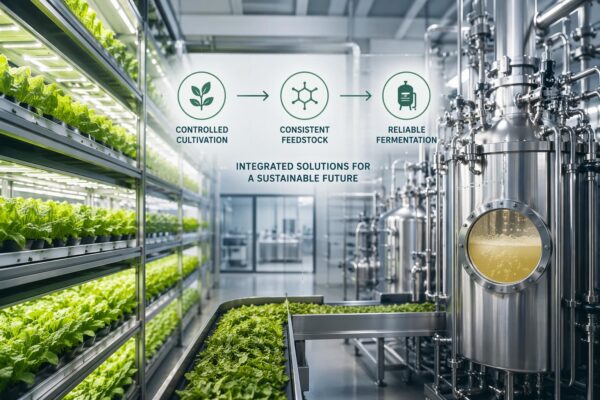
The rapid rise of fermentation and biotechnology in the food sector is receiving significant attention today. Applications such as alternative proteins, new ingredients, and innovative production processes are reducing dependence on traditional agriculture.
What is often less emphasized, however, is that this sector does not operate in isolation. Fermentation relies heavily on reliable, controlled, and consistent input streams—and this is precisely where vertical farming and controlled environment agriculture play a crucial role.
Fermentation Needs More Than a Bioreactor
Traditionally, the fermentation sector focuses on:
- Bioreactors
- Microorganisms
- Downstream processing
In practice, however, the success of fermentation is strongly influenced by what comes before:
- Quality of raw materials
- Composition of sugars and nutrients
- Stability of input streams
- Availability and traceability
In other words, the principle “garbage in = garbage out” applies to fermentation as well.
Many fermentation processes are highly sensitive to variations in:
- Biomass composition
- Contamination levels
- Seasonal fluctuations
- Supply chain variability
These are precisely the areas where traditional agriculture faces limitations.
The Added Value of Controlled Environments
Controlled environment agriculture (CEA), including vertical farming, offers a fundamental advantage in addressing these challenges.
It enables:
Fully predictable input streams
- Consistent composition
- Reproducible quality
- No dependence on seasons
Targeted cultivation for fermentation
- Optimization of sugars, proteins, or specific components
- Tailoring crops for downstream processes
Significant reduction of contamination risks
- Closed systems
- Controlled hygiene
- Lower variability in microbial load
Local production possibilities
- Shorter supply chains
- Reduced logistical complexity
- Better integration with production facilities
As a result, vertical farming becomes not just a production technology, but a strategic link within the fermentation value chain.
From Agriculture to “Feedstock Engineering”
The role of agriculture is fundamentally shifting.
Where traditional agriculture focuses on:
- Yield (tons per hectare)
- Varieties
- Market pricing
A new logic is emerging: “feedstock engineering.”
This involves:
- Producing crops with a specific purpose in a bioprocess
- Optimizing composition rather than volume
- Producing for functionality rather than direct consumption
For fermentation, this is critical. A stable and optimized feedstock can:
- Increase yield
- Improve process stability
- Reduce costs
- Simplify downstream processing
Addressing One of Fermentation’s Biggest Bottlenecks
Many current challenges in fermentation relate to:
- Scaling
- Process stability
- Cost
- Reproducibility from lab to industrial scale
Although these challenges are often attributed to:
- Reactor design
- Strain engineering
Part of the solution actually lies upstream:
👉 in the quality and consistency of input streams
Controlled environment farming can:
- Eliminate variability
- Improve reproducibility in pilot setups
- Facilitate scale-up to industrial production
Integration: Where Real Value Is Created
The greatest opportunity does not lie in standalone systems, but in integration.
Examples include:
- Co-location of cultivation and fermentation
- Direct linkage between biomass production and bioprocesses
- Closed-loop use of nutrients and residual streams
- Optimization of entire production flows
This approach enables:
- More efficient production
- Lower costs
- More sustainable processes
- Reduced dependency on global raw material markets
The Role of Urban Crop Solutions
For a company like Urban Crop Solutions, this represents a clear opportunity.
Not only as a supplier of cultivation systems, but as an enabler of controlled input streams for biotechnological production.
With expertise in:
- Climate control
- Automation
- Closed systems
- Engineering and system integration
UCS can contribute to:
- Production of standardized feedstocks
for fermentation processes - Development of hybrid systems
where cultivation and bioprocessing coexist - Projects within biotech ecosystems
where infrastructure and production are integrated - Integration in pilot and demonstration environments
to accelerate scalability of processes
Not Competition, but Complementarity
It is important to clarify a common misconception:
- ❌ Fermentation and vertical farming are competing systems
- ✅ They are complementary technologies
Fermentation focuses on conversion processes, while vertical farming focuses on controlled production of inputs. Together, they form:
- An integrated system for food production and bio-industrial applications
Conclusion: The Missing Link in Food Biotech
The future of food production does not rely on a single technology, but on the integration of multiple systems.
Fermentation will play a key role in:
- Proteins
- Ingredients
- Biomaterials
But without controlled and reliable input streams, its growth will remain limited.
Controlled environment agriculture—and vertical farming in particular—can fill this gap. Not as an alternative to fermentation, but as a fundamental building block of it.