

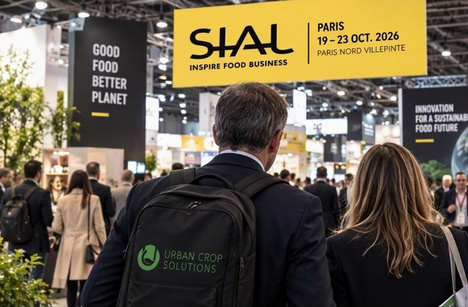
Visiting SIAL Paris offered Urban Crop Solutions an opportunity to step outside the traditional vertical farming and controlled environment agriculture sector and look at the wider food industry.
The visit highlighted several developments that may also be relevant to the future of controlled environment agriculture: the changing meaning of “fresh”, the growing valorisation of food side streams, and the increasingly global nature of food supply chains.
What does “fresh” mean today?
One of the observations that stood out at SIAL was how sophisticated the food industry has become at preserving products and extending their availability.
Semi-finished and fully prepared food products can be frozen, transported over considerable distances and, after a relatively short thawing period, enter refrigerated distribution and retail channels.
From a technological and logistical perspective, this is impressive. At the same time, it raises an interesting question: what do consumers and producers actually mean by “fresh” today?
The food industry has become remarkably good at maintaining product quality over increasingly complex supply chains. But every additional processing, preservation and transport step also increases the distance between production and consumption.
From residual stream to valuable food ingredient
Another striking development at SIAL was the level of innovation around proteins, ingredients and the valorisation of residual streams.
Materials and side streams that might previously have had little or no application in human food are increasingly being turned into new ingredients and food products.
We must admit that some of these applications initially raised some scepticism within our team. However, conversations with producers and technology companies provided a very different perspective.
Using a residual stream does not necessarily mean creating an inferior food product.
On the contrary, we encountered examples where the objective is to make better use of the nutritional value already present in raw materials, rather than allowing potentially valuable components to disappear from the food chain.
For Urban Crop Solutions, that was an important takeaway. Innovation in food production is not simply about producing more. It is increasingly about using what we already produce more intelligently.
A global food market, but at what distance?
Perhaps the most visible characteristic of SIAL is its international character.
Companies and products from Europe stand alongside those from Canada, the United States, China, Australia and many other parts of the world.
This global representation is one of SIAL’s strengths. It brings food cultures, producers, technologies and ideas together in one place, even at a time when geopolitical relationships around the world are increasingly complex.
At the same time, walking through the exhibition makes something else very tangible:
Food travels enormous distances.
Products, ingredients and raw materials move between different regions of the world before reaching their final consumer.
This creates an interesting paradox.
The food industry continues to develop ever more sophisticated technologies to process, freeze, preserve, package and transport food over long distances.
But how sustainable is this model in the longer term?
International food chains are highly dependent on transportation, energy and predictable trading conditions. Changes in fuel and energy prices can affect the economics of moving food over long distances. At the same time, governments are increasingly looking at trade policy, taxation and measures to support or protect domestic industries and strategic sectors.
Import tariffs, transport-related costs and changing trade policies could therefore become increasingly important factors in the economics of internationally traded food.
This leads to a broader question:
How long will it remain economically and environmentally sensible to transport certain fresh products over thousands of kilometres when at least part of that production could take place much closer to the consumer?
This is not an argument against global trade. International trade will continue to be an essential part of the global food system. But perhaps we need to look beyond the cost of producing a kilogram of food and also consider the wider journey that kilogram makes before it reaches the consumer.
Transport, refrigeration, storage, packaging, preservation and potential food losses are all part of that journey.
And this raises another question: should part of our technological effort also be directed towards producing certain fresh products closer to where they are consumed?
Where controlled environment agriculture can contribute
For Urban Crop Solutions, the answer is not that everything should suddenly be produced locally, nor that everything should be grown indoors.
That would neither be realistic nor economically sensible.
Different crops require different production systems, and global agriculture and international trade will continue to play an essential role in feeding the world.
But there are crops and applications where controlled environment agriculture can offer a different approach.
Producing closer to the consumer, under controlled conditions, can shorten supply chains and reduce the distance between harvest and consumption. At the same time, growers gain greater control over production conditions, consistency and quality.
Perhaps controlled environment agriculture should therefore not try to replace conventional agriculture or international food trade.
Instead, it can become one complementary piece of a much larger food-production system, used where local controlled production genuinely creates value.
And perhaps that also changes the way we should evaluate indoor farming.
The question should not only be whether an indoor farm can produce a kilogram of fresh produce at the same cost as conventional agriculture in another part of the world.
We should perhaps also ask:
What is the real cost and value of delivering that kilogram of fresh produce to the consumer?
Production cost remains crucial, of course. But so do transportation, energy, refrigeration, storage, product losses, supply reliability and exposure to increasingly complex international supply chains.
Seen from that broader perspective, local controlled production may have a role that goes beyond simply comparing production costs.
Bringing “fresh” closer again
Our visit to SIAL confirmed just how innovative the global food industry has become.
We are becoming better at preserving food, finding new applications for existing resources and moving products around the world.
These developments are impressive and will remain important.
But perhaps the next step in food innovation is not only about asking:
“How can we keep food fresh for longer?”
It may also be worth asking:
“How can we produce certain foods closer to where they will ultimately be consumed?”
For Urban Crop Solutions, that is one of the questions that made the visit to SIAL particularly valuable.
The future will probably not be global or local, traditional agriculture or indoor farming.
It will most likely be a combination of production methods, each used where it makes the most economic, environmental and practical sense.
Because sometimes innovation is not about making the supply chain longer and more sophisticated.
Sometimes it is about making it shorter.